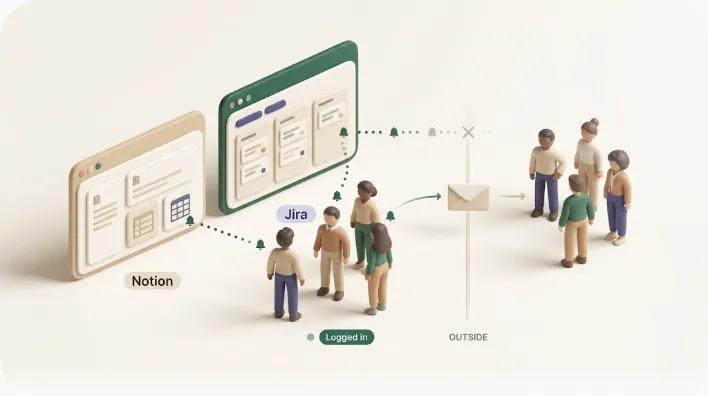
Notion vs Coda: Pricing Models, Features, and the Notification Gap Compared
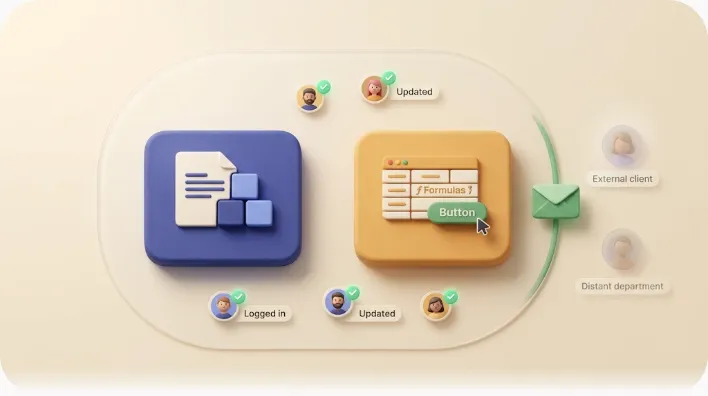
If you're picking between Notion and Coda — or already in one and wondering whether the other would run your operations better — the usual comparisons line up blocks against formulas and stop short of the two things that actually decide it: which team each tool is built for, and a blind spot they quietly share. The headline split is the pricing model — Notion bills per member, Coda bills only the people who build docs — but the bigger surprise is that both tools notify only people who log in. So a client, vendor, or another department that uses neither tool is unreachable through either one, on any plan. This is a third-party comparison of docs, formulas, Packs, pricing models, and integrations, plus the realistic case for running both — with that gap priced in from the start.
TL;DR
- Notion and Coda both fuse "docs + database," but aim it differently. Notion is an easy-to-start all-in-one hub with a rich template and wiki ecosystem; Coda goes deeper on a spreadsheet-like formula language, Packs (external-service integrations), and Buttons/automation.
- The sharpest difference is how you pay: Notion charges per member (editor), while Coda charges only "Doc Makers" — editors and viewers are free. Teams with few builders and many viewers often lean Coda; teams where everyone builds and edits often lean Notion.
- Neither is a straight upgrade of the other — Coda for formula-driven operational logic and automation depth, Notion for ease of use, a documentation hub, and the wider ecosystem.
- Both tools' notifications are built for people who log in. A client, vendor, or non-user department is structurally unreachable — the blind spot most comparisons skip.
- Kapsel is one way to close that last gap for Notion-based teams: it watches your Notion due dates, owners, and statuses, emails people who don't use Notion, and writes a one-click reply back — without sending to items already marked done or paid. (Kapsel integrates with Notion only; it does not connect to Coda.)
The short answer: Notion vs Coda at a glance
Notion and Coda look like twins at first — both put documents and databases in the same surface — but they pull in different directions. Notion optimizes for ease of use, a documentation home, and a huge template ecosystem. Coda optimizes for operational depth: a powerful spreadsheet-like formula language, Packs that pull and push data from external SaaS, and Buttons that run automations inside a doc. So the deciding factor is whether your team's core need is a flexible, easy-to-adopt hub or a doc that behaves like a programmable spreadsheet-app.
| Dimension | Notion | Coda |
|---|---|---|
| Design philosophy | Easy-to-start all-in-one workspace (docs + databases) | A doc that works like a programmable spreadsheet-app |
| Strong at | Docs, wikis, and tasks together; templates; ease of use | Deep formulas, Packs, Buttons/automation, cross-doc sync |
| How logic is built | Properties, relations, rollups, database automations | Spreadsheet-like formula language across tables and buttons |
| Learning curve | Gentle to start | Gentle to open, steeper to master formulas and Packs |
| Billing unit | Per member (editor) | Per "Doc Maker"; editors and viewers free |
| In-app notification reach | Notion account holders who open the app | Coda account holders who open the doc |
| External non-users | Generally not reached | Generally not reached |
| Best-fit team | Doc-heavy, flexible, template-driven teams | Teams building formula-driven internal tools and automations |
The cost of a wrong pick isn't obvious until later: retrofitting a team onto the other tool means migrating documents and rebuilding formulas, relations, or automations after everyone already depends on them.
💡 If you're torn, decide first whether your team's main job is "keeping information and plans together with minimal setup" or "building formula-driven operational logic and automation." Notion for the former, Coda for the latter — and if you want both, the "use both" section below is the realistic answer.
What Notion is built for
Notion is an easy-to-start all-in-one workspace where documents, wikis, and databases live in one place, with a deep template ecosystem. A task is a row (a page) in a database, and you define due date, assignee, status, and priority as properties. The same data shows as a table, board, calendar, or timeline without changing the underlying records, and relations and rollups connect databases to each other. See Notion task management for the base structure, Notion database for how relations and rollups work, and Notion project management for larger setups.
The biggest strength is low friction plus context living with tasks. The block editor is approachable for non-technical people, and the template ecosystem means you rarely start from a blank page — you clone a working setup and adjust. Notes, specs, and knowledge sit next to the tasks they describe, cutting the jump between tools.
The trade-off: Notion's formula and automation layer is lighter than Coda's. Notion has formulas, database automations, and buttons, but they aren't built around a spreadsheet-grade calculation engine or the kind of external data-pull Coda's Packs provide. For heavy operational logic you'll feel the ceiling; weigh Notion's automation limits before leaning on it for complex process.
💡 Notion trades formula depth for approachability and ecosystem. Powerful for doc-heavy, flexible, template-driven teams — lighter if your real need is programmable operations.
What Coda is built for
Coda is an all-in-one doc that behaves like a programmable spreadsheet-app, built around a powerful formula language, Packs, and Buttons. Like Notion it fuses docs and tables, but Coda goes further: its spreadsheet-like formula language runs across tables, controls, and buttons, so a doc can calculate, branch, and act rather than just store. Packs connect external services (pulling and pushing data from SaaS tools), and Buttons/webhooks trigger automations from inside the doc. Cross-doc sync lets one doc read and write another's tables.
The strength is operational depth in a single doc. A team can build an internal tool — an approval flow, a CRM-lite, an inventory tracker — where formulas drive the logic, Packs keep external data current, and a Button runs the next step. What would take a general workspace plus several connectors can live in one Coda doc.
The cost: that power has a real mastery curve, and the "doc" framing can strain at scale. Opening Coda is easy, but getting value from its formula language, Packs, and automations takes investment that a non-technical team may not want to make. And while Coda is excellent as a programmable doc, teams sometimes find very large, many-doc knowledge bases harder to organize than a purpose-built wiki.
💡 Coda's formulas, Packs, and Buttons let you build operational logic a general workspace can't — in return for a steeper path to mastery and a doc-centric model that some large knowledge bases outgrow.
Feature-by-feature comparison
The two tools differ most on formula/automation depth and external-data integration, with ease of use and ecosystem tilting the other way. The table below sets the practical axes side by side.
| Area | Notion | Coda |
|---|---|---|
| Formula engine | Property formulas; capable but not spreadsheet-grade | Deep, spreadsheet-like formula language across the doc |
| Automation | Database automations and buttons; lighter scope | Buttons, webhooks, and formula-driven automation |
| External data | Integrations and the API; no native "pull a SaaS table" layer | Packs pull and push data from external services inside the doc |
| Cross-doc / cross-DB | Relations and rollups within a workspace | Cross-doc sync reads and writes between docs |
| Documentation & wiki | Full docs/wiki home base | Strong as a doc, lighter as a sprawling wiki |
| Templates | Large ready-made template ecosystem | Gallery of doc templates, many for internal tools |
| Ease of use | Gentle; block editor suits non-technical teams | Easy to open; formulas and Packs take time to master |
| Billing unit | Per member (editor) | Per Doc Maker; editors and viewers free |
On integrations, the split mirrors the audience. Coda's Packs are a first-class way to bring external SaaS data into a doc and act on it, which suits teams building operational tools. Notion leans on general-purpose connections and the API — Slack, Zapier/Make, Google Calendar, Figma — with developers building deeper hooks through the Notion API. Both connect to Slack, so Slack is often the shared internal notification channel; for how that plays out, see Notion Slack reminders.
💡 Exact feature scope and plan contents change with each tool's updates. Treat this table as the shape of the difference, and confirm current specifics on each official page before you commit.
Pricing compared — the model matters more than the number
The most important thing about Notion vs Coda pricing isn't the number — it's the billing unit. Notion charges per member (editor): broadly, everyone who edits counts toward the bill. Coda charges only "Doc Makers" — the people who create and build docs — while editors and viewers are free. That single difference reshapes which team pays less.
| Tool | Billing unit | Who pays | Tends to favor |
|---|---|---|---|
| Notion | Per member (editor) | Everyone who edits | Teams where most people build and edit |
| Coda | Per Doc Maker | Only people who create docs | Teams with few makers, many viewers/editors |
| Kapsel | By feature, not headcount | One account chosen by plan | Outward notification regardless of team size |
So if you have a few builders and a large audience that mostly reads or lightly edits, Coda's per-maker model can end up costing much less. If most of your team actively builds and edits, the maker/editor line blurs and Notion's per-member model is often simpler to reason about. Neither is cheaper in the abstract — it depends on the ratio of makers to viewers on your team.
💡 Don't compare sticker prices; compare units. Count how many people would be billable "makers/editors" versus free "viewers" under each model, then apply current official prices. The cost that both comparisons miss is the labor of chasing outside parties by hand — even a cheap core tool leaves that manual reminder work on someone's plate.
Notion's and Coda's exact prices and free-tier limits change with their own plan revisions, so confirm current figures on each official page rather than trusting any amount quoted here. Kapsel's pricing is Free $0 / Standard $12 / Pro $29 per month, and the free plan stays usable at $0.
Who should choose Notion
Notion suits doc-heavy, flexible, template-driven teams that want low setup friction. Editorial and marketing teams, product and design groups, startups, and operations teams that mostly need docs plus tracked tasks get the most from a workspace that's approachable on day one and backed by a large template ecosystem.
The benefit is low friction for mixed, non-technical teams: a writer, a designer, and a founder can all work in the same space without learning a formula language. If your work is more "think, document, plan, and track" than "build programmable operational tools," Notion's ease and ecosystem pay off. For keeping a shared setup coherent, see Notion for team tasks.
- Content, editorial, and marketing teams
- Product and design teams that want specs beside tasks
- Startups and operations teams that value a flexible, easy hub
- Teams that lean on ready-made templates rather than building logic
Where Notion falls short:
- Formula and automation depth is lighter than Coda's
- No native "pull a SaaS table into the doc" layer like Coda's Packs
- Very large, heavily cross-linked databases can slow down as they grow
Who should choose Coda
Coda suits teams building formula-driven internal tools and automations who want operational logic in one doc. If your work depends on calculations across tables, pulling live data from external SaaS, and buttons that run the next step, Coda's formula language, Packs, and automations remove the need to stitch several tools together.
The benefit is depth in a single surface: an ops or revenue team can build an approval flow, a lightweight CRM, or a planning tool where the formulas are the product logic. The steeper path to mastery is the price of that power — and for a team that wants a programmable doc, it's usually worth paying. Coda's per-Doc-Maker billing also helps when a small group builds tools for a much larger audience.
- Operations, revenue, and analytics teams building internal tools
- Teams that need deep formulas and cross-table calculation
- Workflows that pull and push external SaaS data (via Packs)
- Small builder groups serving many free viewers/editors
Where Coda falls short:
- A real learning curve to master formulas, Packs, and automations
- The doc-centric model can strain for very large, sprawling wikis
- Non-technical teams may not want to invest in the depth
Many teams use both, not either
It's tempting to think you must commit to one, but in practice some teams run both with a clear division of labor: Notion as the documentation and wiki hub, Coda for the formula-driven operational tools. Specs, knowledge, and roadmaps live in Notion; the programmable trackers and automations live in Coda. The two connect through import, embeds, and no-code tools so status stays roughly in sync without manual copying. For the wider automation picture, see Notion project management.
That split is the realistic answer most comparisons reach — and then leave unfinished. Because once you run both, there's a new problem.
⚠️ Running both solves the internal division of labor, but it doubles the lock-out for anyone outside. A client, vendor, or another department now faces two systems they don't have accounts for — and neither tool's notifications reach them. The "use both" conclusion quietly makes the external-reach gap bigger, not smaller.
Comparing notifications — the blind spot both tools share
Notifications get overlooked in tool comparisons, but in practice "did the right person notice?" is what moves work forward. Here's how the two compare, and the shared blind spot.
Notion's notifications are built to get a Notion user's attention: an @-mention lands in their inbox, @remind or a date-property reminder fires at a set time, and database automations can trigger in-app or email alerts on changes. All of it reaches only people with a Notion account who open the app — mentioned workspace members. An unopened inbox buries easily.
Coda's notifications work the same way for Coda users: changes, mentions, and automation rules can notify people in-app or by email, and a Button or automation can send an alert when a formula condition is met. Same premise — notifications reach Coda account holders who open the doc. Someone who never logs in to Coda is outside the loop, no matter how clever the formula that fired the alert.
Here's the crux. Both Notion and Coda assume the recipient has an account for that service and looks at the screen. Their notifications are for "people who open Notion" or "people who open Coda" — internal members. It isn't better or worse; it's just which app you get noticed inside.
| Dimension | Notion notifications | Coda notifications |
|---|---|---|
| Core mechanism | Inbox, mentions, reminders, automations | Mentions, automation rules, Button/formula-triggered alerts |
| Who's reached | Notion users / mentioned people | Coda users / mentioned people in the doc |
| Precondition | A Notion account + viewing the screen | A Coda account + viewing the screen |
| External non-users | Generally not reached | Generally not reached |
| Reply loop | A recipient's action doesn't auto-update properties | External person can't act without an account |
⚠️ Both tools' notifications are limited to "can the account holder notice?" — so a client, vendor, or another department without a Notion or Coda account is structurally unreachable through either path, on any plan. When work involves outside parties, that gap turns into manual chase-up emails. For the deeper "share versus notify" distinction, see external share notifications.
This is also where the "use both" plan hits its real limit. Connecting Notion and Coda keeps internal status in sync, but it only moves information inside the two ecosystems. Neither connector nor native alert reaches someone who holds neither account — so two tools means two walls, not a bridge to the outside.
Keep Notion, reach the people outside it
For teams that keep Notion as the hub, the external-reach gap isn't solved by "switching to Coda" or by stacking more automations inside Notion. It's solved by carrying Notion's due dates out into email anyone can receive. Here's how Kapsel fits, described factually. (Kapsel integrates with Notion; it does not connect to Coda.)
Kapsel is a Notion notification tool that watches the due dates, owners, and statuses in your Notion database, sends automatic email reminders to people who don't use Notion, and lets recipients write the status back to Notion with one click. No API, script, or external automation build required — you connect Notion and go. It sits alongside Notion rather than replacing it.
| Problem (unsolved in Notion or Coda) | Kapsel's shipped feature | Effect |
|---|---|---|
| Want to send based on due date, owner, status | Watches due/owner/status → automatic email reminder | Reach "due soon / already overdue" without waiting on a change |
| Doesn't reach external non-users | Emails reach people without a Notion account | Recipient needs no login — they just get an email |
| Notifications are one-way; status doesn't return | One-click writes back to Notion (two-way) | The recipient's action updates the status, keeping Notion current |
| Risk of chasing someone who already finished or paid | Never sends to completed or paid items | Resolved parties drop out of scope automatically |
| Want to chase overdue items unattended | Overdue follow-ups / filtering / scheduled sends | Only overdue items, filtered by condition, on a set cadence |
| Don't know who received it / rewriting copy each time | Send logs / merge variables | History is kept; drop in name, date, and amount to reuse |
Put together, the due dates you already keep in Notion start reaching the people responsible for them — including a client or vendor who never opens Notion — without you writing another manual reminder. For reaching people who don't use Notion more broadly, see reminders for non-users, and for keeping outside stakeholders in the loop, see Notion client updates.
If you need to watch across multiple Notion workspaces or set sender branding (company name, signature, logo), the Pro plan covers that. For exact figures, see the official pricing page — Free, Standard, and Pro tiers.
⚠️ The accident to avoid most in automated outward notifications is chasing someone who already finished or paid. Because Kapsel reads status, it doesn't send to items marked done or paid in the first place. Whether "not sending" is guaranteed by default is an important axis when choosing an outward-notification approach.
Frequently Asked Questions
Is Coda a good replacement for Notion?
It depends on what you use Notion for. If you mainly need a documentation and wiki hub with a gentle learning curve and a large template ecosystem, Coda is not a direct replacement. If your real need is formula-driven operational tools — calculations across tables, external data via Packs, buttons that run steps — Coda can absorb work Notion handles only lightly. For many teams they solve adjacent, not identical, jobs.
Which is cheaper, Notion or Coda?
It depends on your team's shape, because the billing unit differs. Notion charges per member (editor), while Coda charges only "Doc Makers" — the people who build docs — leaving editors and viewers free. A team with a few builders and many viewers often pays less on Coda's model; a team where most people actively build and edit often finds Notion's per-member model simpler. Count your makers versus viewers, then apply current official prices rather than any figure quoted secondhand.
Can Notion do the formula-driven things Coda does?
Partly. Notion has property formulas, database automations, and buttons, so you can build real logic. But Coda is built around a spreadsheet-like formula language that runs across the whole doc, plus Packs for external data and richer automation — so deep calculation and SaaS-data workflows are things Coda ships and Notion would require you to approximate. For heavy process, weigh Notion's automation limits first.
Can you use Notion and Coda together?
Yes, and some teams do — Notion as the documentation and wiki hub, Coda for the formula-driven operational tools. You can connect them with import, embeds, and no-code tools so internal status stays roughly in sync. Note that these connections move information only inside the two ecosystems and still don't reach anyone outside both.
Does Coda send email notifications the way Notion does?
Both can send email alerts, but both assume the recipient has an account for that service. Notion emails mentioned members and reminder recipients; Coda emails people in the doc when a change, mention, or automation fires. Neither emails a client or vendor who has no account — reaching them requires a separate outward channel such as Kapsel.
What happens to a client or vendor who isn't on Notion or Coda when a deadline hits?
Nothing automatic — neither tool's notifications can reach someone without an account, so the deadline passes silently on their side until someone emails them manually. Closing that gap takes an outward layer that emails the person directly; Kapsel does this for Notion and writes their one-click reply back, without sending to items already completed or paid.
Can I migrate from Coda to Notion, or the other way around?
Both tools let you import structured data (CSV-style exports) to rebuild tables or databases, but neither offers a one-click, lossless migration — formulas, Packs, relations, and automations typically need to be rebuilt by hand in the destination tool. Treat a switch as a deliberate rebuild of your logic rather than a file transfer, and budget time for remapping statuses, fields, and any automation rules.
Notes & sources
Published October 13, 2026. Descriptions of Notion's standard features (databases, views, @remind, date-property reminders, database automations, mention notifications) and Coda's features (docs, tables, the formula language, Packs, Buttons/automation, cross-doc sync, mention and automation notifications) and the integration, import, and pricing-model notes here are based on each service's official documentation and general behavior as of writing. Menu names, feature scope, plan contents, and pricing — including the per-member versus per-Doc-Maker billing models — change with updates, so confirm current details against each official source (Notion Help Center and Coda's official docs and pricing pages). The tables show the shape of the difference, not guaranteed figures. For other comparisons in this series, see Notion vs Jira and Notion vs Confluence. Kapsel's features and pricing referenced here are current as of writing; see the official pricing page for the latest.