Notion vs Airtable: Flexible Info Hub vs Serious Relational Database
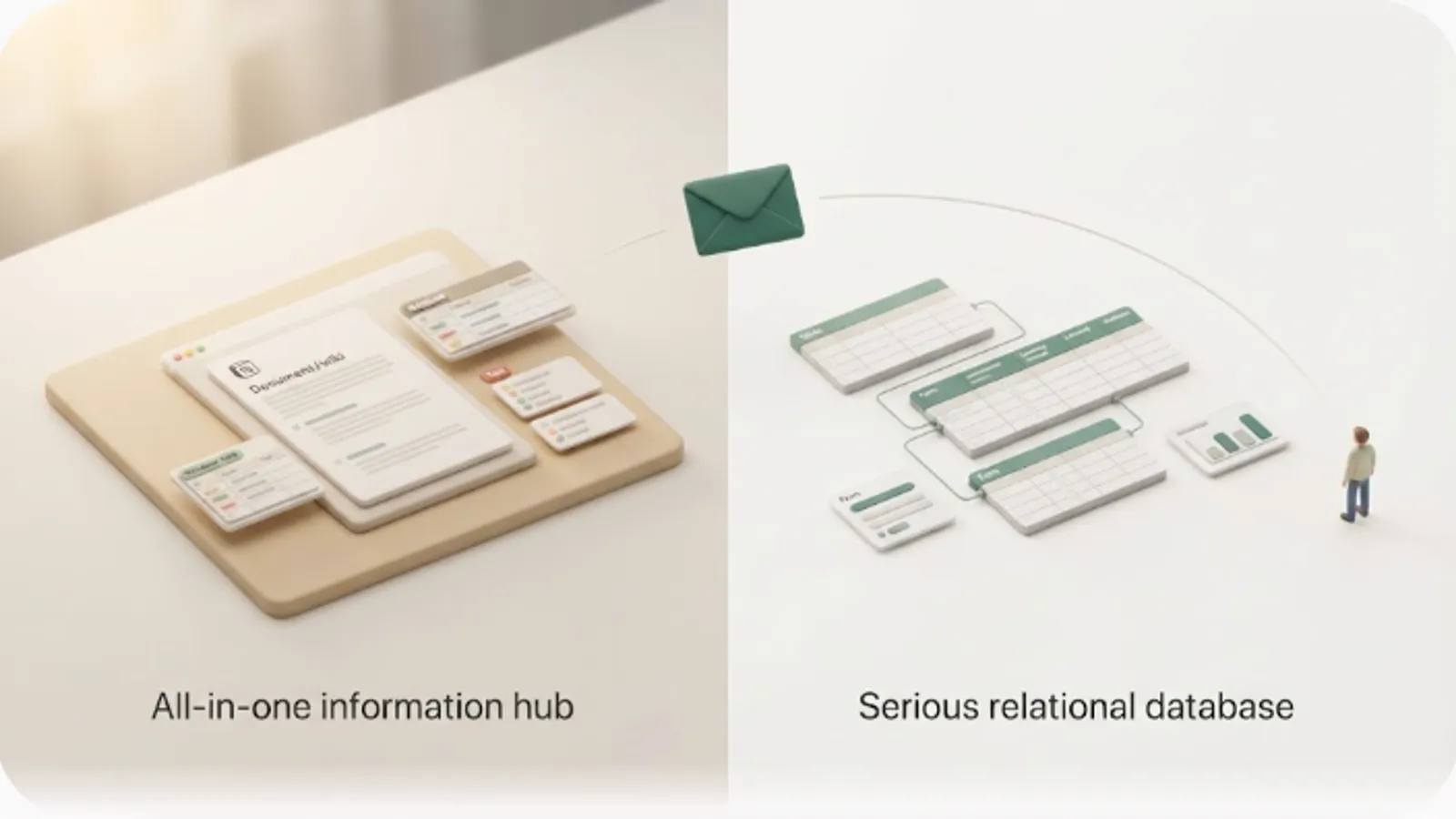
Most Notion vs Airtable write-ups line up two tools that both show data in a grid, then stop short of the thing that actually decides it: these two solve different problems, and neither cleanly delivers a two-way reminder over your Notion data to someone without an account — a blind spot almost no comparison mentions. If you're choosing between them, or wondering why your reminders and automations still never close the loop with the person outside your workspace, this is for you.
TL;DR
- Notion is a flexible all-in-one information hub; Airtable is a serious cloud relational database (a no-code data platform). Notion pulls docs, databases, and tasks into one place; Airtable is built around records, rich field types, linked tables, interfaces, and automations with data as the main character. Pick by whether you want to centralize information with documents or model and run structured data seriously.
- Airtable's strengths are relational fields (linked records, lookups, rollups), forms, Interface Designer, and trigger-and-action automations. Notion is stronger at keeping documents, wikis, and notes in the same place as the data.
- Both tools' in-app notifications are built for the account holder who logs in. But to be fair, Airtable's Automations include a "Send email" action that can email external addresses one-way — a step beyond Notion's native reminders.
- Even so, a recipient's one-click write-back (two-way) and a status-aware "don't send to done/paid" guard are hard to build in either tool by default. And if your source of truth is Notion, Airtable's email is about Airtable records — it doesn't carry your Notion due dates out on its own.
- Kapsel is one option to close that gap: it watches your Notion due dates, owners, and statuses, emails people who don't use Notion, and writes a one-click reply back to Notion — without sending to items already marked done or paid.
These two aren't really head-to-head competitors — they're built for different jobs. Notion is a flexible workspace for documents, databases, and tasks; Airtable is a serious cloud database built around records, linked tables, interfaces, and automations. This is a third-party look at that role difference, plus the shared gap above: both tools' in-app notifications are for people who log in, and while Airtable can email outsiders one-way, a two-way loop over your Notion data to a non-user isn't something either closes on its own. If that outward-reach gap turns out to be your only real complaint, you may not need to switch tools at all — see Notion's honest automation limits to tell a fixable gap from a real reason to migrate.
The short answer: Notion vs Airtable at a glance
Here's the conclusion up front. Notion is a flexible information hub; Airtable is a serious relational database. Notion centers on documents and databases to pull everything into one place, with data living alongside the wiki and tasks you design yourself. Airtable centers on records and rich field types — linked records, lookups, rollups, attachments, formulas — so you can model related data like "Clients," "Projects," and "Invoices" as separate tables that connect. So the deciding factor is whether you want to centralize information with documents or model and run structured data seriously.
| Dimension | Notion | Airtable |
|---|---|---|
| Design philosophy | All-in-one information hub (docs + databases + tasks) | Serious cloud relational database (data-first) |
| Strong at | Notes, specs, wikis, and tasks living together | Relational data, forms, interfaces, automations |
| Unit of data | A row (page) in a database with properties | A record in a table with rich field types |
| Relations | Relations and rollups exist (lighter-weight) | Linked records, lookups, rollups at the core |
| Views | Table, board, calendar, timeline (you set them up) | Grid, Kanban, Calendar, Gallery, Form (Gantt/Timeline on higher plans) |
| Documents | Docs and wikis live freely inside pages | Not a home base for documents or wikis |
| Automation | Database automations (change-triggered) | Trigger-and-action automations (incl. a Send email action) |
| In-app notifications reach | Notion users / mentioned members | Airtable users / mentioned in comments |
| Outward one-way email | Thin by default | Automations can email external addresses |
| Two-way outward loop | Hard to build by default | Hard to build by default |
| Best-fit use | Centralizing team information and knowledge | Modeling and running structured data seriously |
Getting this call right early matters, because the cost of a wrong pick shows up later: bending a flexible workspace into a strict database, or forcing a data tool to become your knowledge base, means fighting the tool after everyone already depends on it.
💡 If you're torn, decide first whether your main goal is "gathering information (with documents) in one place" or "modeling structured data seriously." Notion for the former, Airtable for the latter — and the "use both" section below is the realistic answer if you want each for what it's best at.
How Notion handles data
In Notion, data management lives inside documents — an information-hub model. A record is a row (a page) in a database, and you define due date, assignee, status, and tags as properties. The same data can appear as a table, board, calendar, or timeline, switching the view without changing the underlying data. Relations and rollups let you connect databases, too. See how to set reminders in Notion for date-based nudges.
The biggest strength is that documents and data live in the same place. You can embed a database inside meeting notes, specs, or a wiki, or write background and discussion directly into each row's (page's) body — so you jump to another tool less often to find information. It suits people who want to keep not just the data but its context and knowledge in one place.
The flip side: for database rigor and handling large volumes of data, the purpose-built Airtable has the edge. The range of field types, relational rollups, and operating on many records at once are often smoother in a tool designed for data. Notion is an "information hub" first, with the database as one part of it. See Notion's database basics for how its databases work.
💡 Notion's database shines because data lives together with documents. In return, if you need pure database depth — field types, relational aggregation, large datasets — Airtable fits some situations better.
How Airtable handles data
Airtable is a serious cloud relational database that starts from a spreadsheet-like feel. A record is a row in a table, and beyond text, numbers, dates, and single/multi-select, you can structure data with rich field types — linked records, lookups, rollups, attachments, and formulas. Linking tables to one another is the core, so modeling "Customers," "Projects," and "Invoices" as separate but connected tables comes naturally.
Views include Grid, Kanban, Calendar, Gallery, and Form (Gantt and Timeline on higher plans), switching the same data by purpose. On top of that, Interface Designer lets you build lightweight app-like screens and dashboards over the data, so it doubles as a simple internal tool for input and viewing. Forms collect data from outside, and Automations (triggers plus actions) can create or update records, post to other services, and send emails — the makings of a real data backbone.
In exchange, Airtable isn't a home base for documents or knowledge the way Notion is. Records take descriptions and attachments, but it isn't built to combine wikis, notes, and relational databases into a flexible information foundation. It's optimized for treating data as the main character. (Feature specifics and plan boundaries change; confirm current details against Airtable's own documentation.)
💡 Airtable's strengths are relational structure, forms, interfaces, and automations — great for making data the main character. In return, flexible document and knowledge management isn't its focus; that's Notion's territory.
Comparing notifications — the blind spot both share
Notifications are exactly where this comparison gets interesting, because a lot of people lean toward Airtable precisely for its automations, forms, and the ability to wire things up. So it's worth being clear about what those can and can't do.
Notion's notifications are built to nudge the person using Notion: @-mention someone and it lands in their inbox, a date-property reminder or @remind fires at a set time, and database automations can trigger in-app or email notifications on a property change. All of this reaches people with a Notion account who look at the screen — mentioned workspace members. Reaching outsiders by email isn't really the native model.
Airtable's notifications start the same way — in-app notifications and @-mentions in record comments reach collaborators who log in. But here's a fair difference worth naming: Airtable's Automations include a "Send email" action, so a trigger (record created/updated, enters a view, a scheduled time) can fire a one-way email to any address, not only collaborators. For pushing an outward "heads-up" email automatically, that's a step ahead of Notion's native reminders.
Here's the crux. In-app notifications in both tools are for members who log in. Airtable's email action does reach outside addresses — but it's fundamentally one-way. Having the external recipient click once to write the record's state back (handled, paid, etc.) — a two-way loop — is hard to build by default (Interface viewing needs a collaborator seat or permissions, and forms are mainly for new submissions, not updating a specific existing record). And if your source of truth is Notion, Airtable's email is about Airtable records — you'd have to move your data into Airtable and rebuild the automation, and the reply-back problem still remains. It isn't better-or-worse notifications — it's which app it runs inside and how far out it reaches.
| Dimension | Notion notifications | Airtable notifications |
|---|---|---|
| Core mechanism | Inbox, mentions, date reminders | In-app notifications, comment mentions, automations |
| Outward one-way email | Thin by default | A "Send email" automation can reach external addresses |
| Who's reached in-app | Notion users / mentioned people | Airtable users / mentioned in comments |
| Precondition | A Notion account + viewing the screen | An Airtable account + viewing (external email is the exception) |
| State write-back from outside | A recipient's action doesn't auto-update properties | One-way mainly; two-way is hard to build by default |
| Excluding done/paid | You design the condition yourself | You design the trigger condition yourself |
⚠️ Airtable is a step more "outward" than Notion because it can email outsiders. But two things remain: ① it's one-way, so state doesn't come back, and ② it assumes Airtable records (a migration cost if Notion is your source of truth). In external work, what pays off isn't just "it arrives" but "the state comes back (two-way)." For reaching people who don't use the tool, see why external sharing doesn't notify anyone.
Pricing compared
Weigh pricing not just as a monthly fee, but including the real operating cost of chasing external parties (manual emails, or migrating data just to rebuild automations). Here we set Notion's and Airtable's pricing bands alongside Kapsel as an outward-notification option.
| Tool | Role | How pricing works |
|---|---|---|
| Notion | Information hub | Free plan available. Paid is billed monthly per member, expanding features, history, and permissions |
| Airtable | Relational database | Free plan available (with record caps and other limits). Paid tiers are billed per seat monthly, expanding record limits, automation runs, and interfaces |
| Kapsel | Outward-notification layer | Free $0 / Standard $12 / Pro $29 per month. Chosen by feature, not headcount |
💡 The cost that gets missed in pricing comparisons is the labor of chasing outside parties by hand — or moving data to another tool just to rebuild the automation. Even if the core tool is cheap, sending reminder emails manually every time is a hidden cost. Weigh the price of automating outward notifications against that manual cost.
Airtable's exact tiers, seat pricing, record caps, and automation-run limits change over time, and Notion's prices change with its own revisions — confirm figures on each official page. Kapsel's pricing is Free $0 / Standard $12 / Pro $29 per month, and the free plan stays usable at $0.
Integrations and the realistic case for using both
It's tempting to think you must commit to one, but some teams run both — Airtable for relational, high-volume data, Notion for team information and knowledge. The main ways to connect them:
- Import/export to consolidate — move or copy data via CSV to keep existing records on one side.
- Sync/embed to display — surface information in Notion so one tool's data is visible alongside the other.
- Connect with no-code tools — build automations like "a record updates in Airtable → update the Notion page" with Zapier or Make. Airtable also has its own automations and API for connecting other services.
A common split is Airtable as the relational data backbone and Notion as the shared information hub — you model and aggregate structured data in Airtable while specs, notes, and knowledge live in Notion. For broader tool-vs-tool views, compare Notion vs Asana, Notion vs ClickUp, and Notion vs Monday.com.
⚠️ Connectors are convenient, but they carry their own operating costs — trigger design, message upkeep, and usage-based billing on run counts. And these connections only move information inside the Notion/Airtable ecosystems; they don't guarantee a two-way exchange with an outside party. Even with a connector in place, a two-way outward loop still needs a separate method.
Which one suits you
Pick based on "does it fit how my team works," not on which has more features. Here's the split, plus the axis comparisons tend to miss: work that involves outside parties.
Notion suits people and teams who want documents, databases, and tasks in one place — startups, planning and editorial teams, and projects that want notes, specs, and knowledge living alongside their data and are willing to design their own conventions.
Airtable suits people and teams who want to model and run structured data seriously — linking customers, projects, or inventory as related records, collecting data with forms, building input/view screens with interfaces, and automating record updates and emails. It fits large data volumes, complex relations, and building lightweight internal tools.
But classifying by internal use alone misses work that deals with outside parties day to day. Freelancers, agencies, and small businesses often have clients, contractors, or customers on the other side of the work — most of whom use neither Notion nor Airtable. Airtable can at least email them one-way, but a two-way loop where they write the state back is hard by default, and if Notion is your source of truth you're left either migrating to Airtable or chasing by hand — something a tool-vs-tool comparison can't solve. For the client-facing angle, see client updates from Notion.
| Situation | Better fit |
|---|---|
| Want docs + databases + tasks in one flexible workspace | Notion |
| Want a serious relational database with interfaces and automations | Airtable |
| Want each for its strength (data backbone + shared info) | Both (divide the labor) |
| Clients or contractors involved in the work | Either — plus a separate two-way outward layer |
💡 Fit isn't decided by "info person vs. data person" alone. When outside parties are part of the flow, you need a third axis beyond the tool comparison: how do you reach people outside the tool — and get their reply back?
Staying on Notion but strengthening outward notifications
As above, Notion's notifications are for account holders, and Airtable can email outsiders one-way but makes a two-way, status-aware loop hard — and neither carries your Notion due dates out two-way on its own. That gap isn't solved by "switching to Airtable" or "keeping everything inside Notion" — it's solved by carrying Notion's due dates out into email that anyone can receive, and pulling the recipient's action back into Notion. Here's how Kapsel fits, described factually.
Kapsel is a Notion notification tool that watches the due dates, owners, and statuses in your Notion database, sends automatic email reminders to people who don't use Notion, and lets recipients write the status back to Notion with one click. No API, Apps Script, or external automation build required — you connect Notion and go. It sits alongside Notion rather than replacing it.
| Problem (easily left unsolved in Notion or Airtable) | Kapsel's shipped feature | Effect |
|---|---|---|
| Want to send based on due date, owner, status | Watches due/owner/status → automatic email reminder | Send to "due soon / already overdue" without waiting for a change |
| Want to reach external non-users with Notion's content | Emails reach people without a Notion account | Recipient needs no login — they just get an email |
| Notifications are one-way; status doesn't return | One-click writes back to Notion (two-way) | The recipient's action updates the status, keeping Notion current |
| Risk of chasing someone who already paid | Never sends to completed or paid items | Resolved parties drop out of scope automatically |
| Want to chase overdue items unattended | Overdue follow-ups / filtering / scheduled sends | Only overdue items, filtered by condition, on a set cadence |
| Don't know who received it / rewriting copy each time | Send logs / merge variables | History is kept; drop in name, date, and amount to reuse |
Put together, this means the due dates you already keep in Notion start reaching the people responsible for them on their own — and come back with one click — without you writing another manual reminder email.
If you want to watch across multiple Notion workspaces, or set sender branding (company name, signature, logo), the Pro plan covers that.
⚠️ The accident to avoid most in automated outward notifications is chasing someone who already paid or finished. Because Kapsel reads status, it doesn't send to items marked done or paid in the first place. Whether "not sending" is handled by default is an important axis when choosing an outward-notification approach.
Kapsel is an indie project (getkapsel.com) — it exists because chasing people manually is miserable, and the "don't send to the wrong person" guardrail is the part built most carefully.
FAQ
Notion vs Airtable — which is better?
There isn't a single better one; they're built for different jobs. If you want documents, databases, and tasks managed together and the whole information hub designed your way, Notion fits. If you want to model structured data seriously — linked records, lookups, rollups, forms, interfaces, and automations with data as the main character — Airtable fits. They play different roles, so using both is common. Either way, a two-way exchange with external non-users is the one thing you'll want to cover separately.
Is Airtable free?
Airtable has a free plan, but it generally caps records and automation runs, and paid tiers are billed per seat monthly. Record limits, interfaces, and automation scope vary by plan. Exact figures and free-tier scope change over time, so confirm them on Airtable's official pricing page before relying on a specific limit.
Which is the more serious database, Notion or Airtable?
For pure database depth — the range of field types, relational aggregation via linked records/lookups/rollups, handling large record counts, and turning data into screens with interfaces — Airtable tends to be stronger. Notion also has relations and rollups, but its strength is being an information hub where data lives together with documents and wikis, with the database as one part of that.
Can Airtable email external people?
Yes. Airtable's Automations include a "Send email" action, so a trigger (record created/updated, a scheduled time, and so on) can automatically send a one-way email to external addresses, not just collaborators. Note that this is essentially a heads-up — having the recipient click once to write the record's state back (a two-way loop) is hard to build by default.
How do I send a two-way reminder of a Notion due date to an external client?
Notion's notifications are for logged-in members and don't reach external non-users. Moving to Airtable lets you send one-way emails, but it doesn't give you the recipient's write-back or keep Notion as your source of truth. To reach someone without a tool and pull their action back, you need something that watches Notion's due dates and statuses and emails out. Kapsel does exactly this — it emails people who don't use Notion and lets them write the status back to Notion with one click. See why external sharing doesn't notify anyone for the underlying reason outsiders aren't reached.
Can Notion and Airtable be integrated?
Yes, to a degree. You can import/export data via CSV, display information together, or build no-code automations like "a record updates in Airtable → update the Notion page" with Zapier or Make; Airtable also has its own automations and API. Note that these connections move information inside the Notion/Airtable ecosystems and don't guarantee a two-way exchange with an outside party who uses neither tool.
Can I automatically chase overdue items without sending to people who already finished?
Not from Notion's built-in notifications alone, and Airtable's email action would need you to design the condition and rebuild on Airtable records. Kapsel handles this specifically: it sends overdue follow-ups by email on a set cadence, filtered by condition, and because it reads status, it doesn't send to items already marked done or paid.
Notes
Published October 9, 2026. Descriptions of Notion's standard features (databases, views, relations/rollups, @remind, date-property reminders, database automations, mention notifications) and Airtable's features (tables, records, field types including linked records/lookups/rollups/attachments/formulas, views including Grid/Kanban/Calendar/Gallery/Form with Gantt/Timeline on higher plans, Interface Designer, Automations with triggers/actions including the Send email action, comment/mention notifications) here are based on each service's official documentation and general behavior as of writing. Menu names, feature scope, plan contents, pricing, seat pricing, record caps, automation-run limits, and which features sit behind a paid tier all change with updates, so confirm current details against each official source (Notion Help Center, Airtable official help and pricing). External integration tools such as Zapier and Make are third-party services with their own pricing and limits; confirm those separately. Kapsel features and pricing referenced here (USD: Free $0 / Standard $12 / Pro $29 per month) are implemented as of writing; see getkapsel.com for the latest.