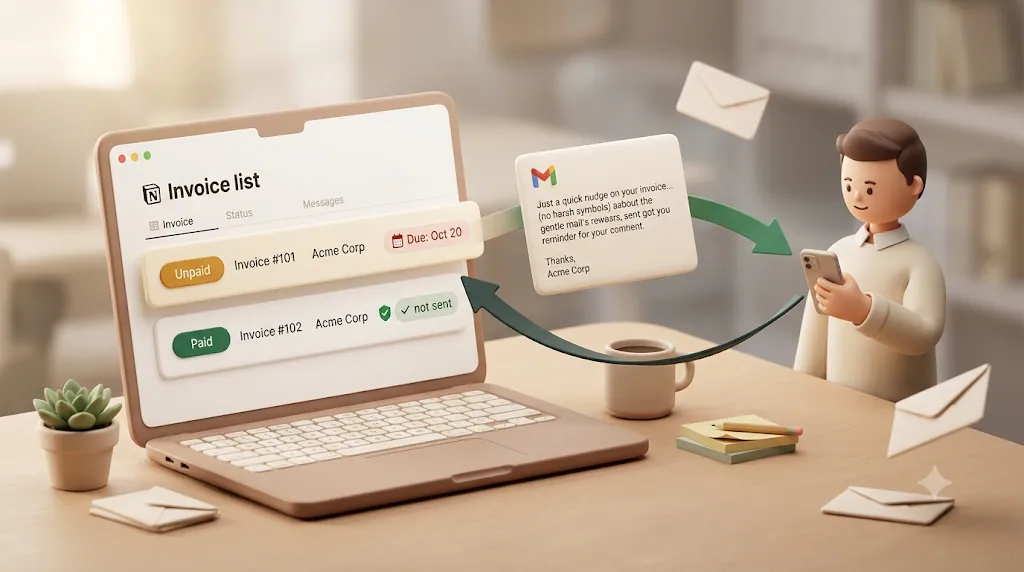
How to Chase Late Payments From Clients: A Staged Escalation Guide (Reminder to Final Demand and Collections)

Asking a client for money they already owe you is one of the most uncomfortable emails a freelancer or small agency ever has to send — uncomfortable enough that people either avoid sending it, or send an angry one that burns a good relationship over what was probably an accident. This guide lays out a calmer alternative: a staged escalation playbook that moves a late payment through the same predictable rungs — a warm reminder first, then a firmer follow-up, then a formal notice, and only at the end, collections or court — so you always know which stage a given invoice is on and how to move it to the next one on a schedule instead of on impulse.
TL;DR
- Treat late-payment chasing as a staged escalation ladder, not a single follow-up. Tone starts warm and gets more formal as days pass; the core details (invoice number, amount, due date, new deadline) stay the same throughout.
- Rough timeline: friendly reminder (due date to ~1 week late) → firmer follow-up (~1–3 weeks) → pause work and formal notice (~30–45 days) → demand letter → collections or small claims (~60–90+ days).
- Which path is "right" depends on the amount owed, how overdue it is, whether the relationship is worth saving, and your paper trail — the decision table below maps each case.
- Doing this by hand across many clients is where it breaks down. Kapsel watches your Notion invoice tracker, sends the reminders, never contacts a client who already paid, and logs everything — so you're tracking stages instead of copy-pasting templates.
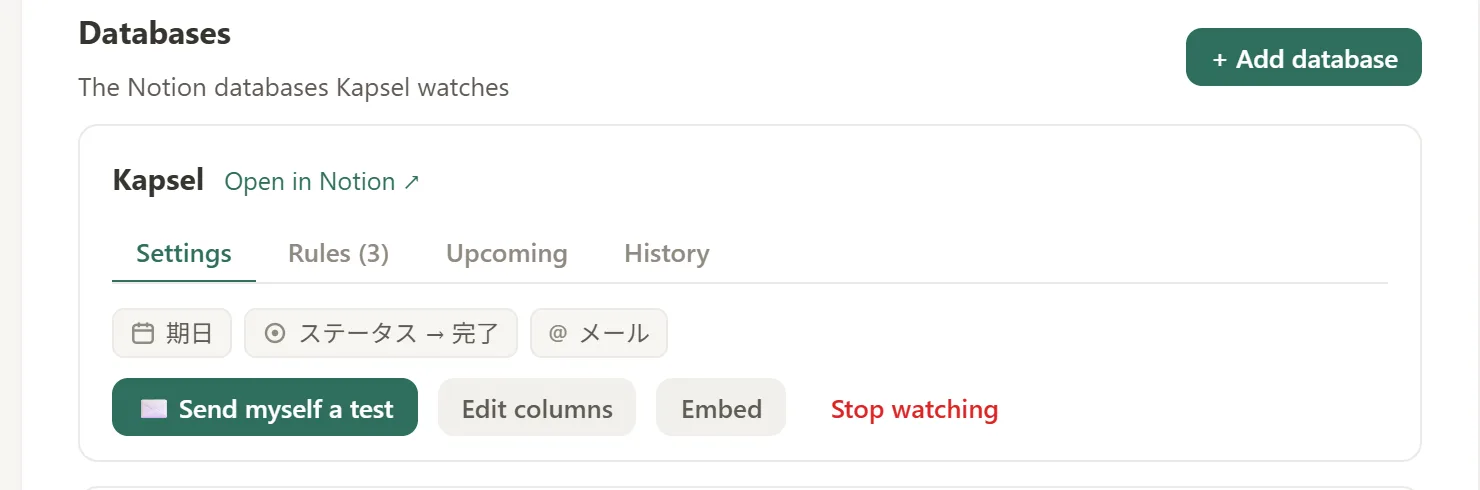
💡 Definition: Kapsel is a Notion notification tool that watches your database's due dates, assignees, and statuses and sends automatic email reminders to people who don't need a Notion account, with a one-click confirmation in each email that writes the status back to Notion.
⚠️ This article is general information, not legal advice. Collections rules, late-fee limits, small-claims thresholds, and court procedures vary widely by country and state. Confirm the current rules for your jurisdiction with a qualified professional or your local court before taking any formal or legal step.
Why late-payment chasing works best as a staged escalation, not a single follow-up
Most unpaid invoices are not refusals — they are oversights, cash-flow gaps, or an email buried in a busy inbox. A single angry follow-up treats every case as bad faith and can burn a good client over what was really an accident. A staged escalation, by contrast, gives an honest client several easy chances to pay while steadily building the record and pressure you'd need if they turn out to be a genuine non-payer.
The other reason to stage it: escalation should be earned by time, not triggered by frustration. When you decide in advance that day 3 gets a gentle nudge and day 30 gets a formal notice, you remove emotion from the decision. You are not "being harsh" — you are following a policy you'd apply to anyone. That consistency is what keeps the process professional and defensible if it ever reaches a demand letter or court.
💡 Escalate the clarity and formality of your message over time — never the hostility. A calm, factual tone protects the relationship even when a payment is badly overdue, and it reads far better if a third party (a mediator, a collections agent, a judge) ever sees the thread.
The escalation ladder at a glance

Here is the whole ladder in one view. Treat the day ranges as defaults you adjust to your contract and your relationship with the client, not hard rules. For copy-ready wording at each rung, see payment reminder email templates.
| Stage | Rough timing | Tone | Goal |
|---|---|---|---|
| 1. Gentle reminder | Due date → ~1 week late | Warm, assumes good faith | Nudge an honest oversight; make paying easy |
| 2. Firmer follow-up | ~1–3 weeks late | Polite but direct, adds a deadline | Get a commitment and a payment date |
| 3. Pause work + enforce terms | ~3–4+ weeks late | Professional, matter-of-fact | Use leverage; stop the balance growing |
| 4. Formal final demand | ~30–45+ days late | Formal, unemotional | Last chance before legal/collections, in writing |
| 5. Collections or small claims | ~60–90+ days late | Handed off / legal | Recover the debt through a third party |
⚠️ Day ranges are conventions, not law. A retainer client who pays every month might earn a longer leash; a first-time client who has gone dark warrants faster escalation.
Stage 1 — The gentle reminder (due date to ~1 week late)
The first reminder assumes the best. At this point the invoice is only days late, and the most likely explanation is that your client simply hasn't gotten to it. Your job is to make paying effortless and give them zero reason to feel defensive.
What to include and why the tone should assume good faith
Even a friendly reminder should be complete enough to act on without hunting for the original invoice. Include:
- Invoice number and a one-line description of the work.
- Amount due and the original due date.
- Accepted payment methods (and a fresh copy or link to the invoice).
- A soft, open close ("let me know if anything's unclear").
Keep the tone warm and low-stakes. A gentle first nudge signals that you're organized and attentive without accusing anyone of anything — which is exactly the reputation you want if the invoice later needs firmer handling.
Example gentle reminder script
Subject: Quick note on Invoice #123
Hi [Client],
Just a friendly heads-up that Invoice #123 for [amount], due on [date], is showing as unpaid on my end. It may already be on its way — if so, please ignore this.
Payment details are on the invoice (I've reattached it here), and I'm happy to resend it in another format if that's easier. Thanks so much!
[Your name]
Stage 2 — The firmer follow-up (roughly 1–3 weeks late)
If the gentle reminder goes unanswered, the invoice moves from "probably an oversight" to "needs a real response." The tone stays professional, but the message gets more direct and, crucially, introduces a specific new deadline instead of an open-ended "whenever."
Adding a clear deadline, referencing late fees if your contract allows them
A follow-up without a deadline is just another reminder. Give the client a concrete date to pay by, and restate the full facts so the message stands on its own:
- Invoice number, amount, and original due date.
- A new deadline ("please arrange payment by [date]").
- Accepted payment methods.
- If — and only if — your signed contract or invoice terms provided for it, a note that late fees may apply.
⚠️ Only mention or charge a late fee if it was agreed in writing before the work started (in your contract or on the invoice). Whether a late fee is enforceable, and any cap on it, varies by jurisdiction — check your local rules before relying on one.
When a phone call beats another email
Around the two-to-three-week mark, a short, friendly phone call often unsticks a payment faster than a fifth email. A voice conversation is harder to ignore, surfaces the real reason for the delay ("we're waiting on our own client," "the invoice went to the wrong person"), and lets you agree on a payment date on the spot. Always follow up the call with a brief email confirming what you agreed — that written summary becomes part of your paper trail.
Stage 3 — Pausing work and enforcing your terms (roughly 3–4+ weeks late)
Once an invoice is significantly overdue, continuing to deliver work simply grows the amount at risk. For ongoing or retainer clients, pausing work is your strongest non-legal leverage — it converts an abstract overdue invoice into an immediate, concrete consequence.
How to pause without burning an ongoing client relationship
Frame the pause as policy, not punishment. You are not walking off the job in anger — you are following a standard practice that protects both sides.
- Give notice, in writing. State that work will pause on [date] until the outstanding balance is cleared, and reference the specific invoice(s).
- Keep it neutral. "To keep our accounts current, I pause active work when an invoice passes [X] days overdue" reads very differently from "I'm stopping until you pay."
- Make resuming easy. Confirm that work resumes as soon as payment clears, so the client sees a clear path back to normal.
💡 Build the right to pause into your contract from the start ("services may be suspended if an invoice is more than X days overdue"). Then pausing is simply enforcing agreed terms, which is far easier to say — and to defend — than an improvised ultimatum.
Stage 4 — The formal final demand / demand letter (roughly 30–45+ days late)
If polite and firm follow-ups have failed, the next rung is a formal final demand — sometimes called a past-due notice or, at its most serious, a demand letter. This is the last step before you hand the matter to a third party, and its tone should be formal and unemotional. It is written as much for a future reader (a collections agent or a court) as for the client.
What a demand letter needs to state
A demand letter is a clear, businesslike document — not an angry email. At a minimum it should state:
- The total amount owed, including any contractually agreed late fees or interest.
- The invoice number(s) and original due date(s).
- A firm final deadline to pay (commonly a set number of days from the letter).
- The accepted payment methods.
- The consequences of continued non-payment — that you will pursue further action such as collections or legal proceedings.
Send it in a way that creates a record of delivery, and keep a copy. Many people have a lawyer draft or review the demand letter at this stage; a letter on an attorney's letterhead often prompts payment on its own, and a professional can make sure the wording fits your jurisdiction.
Jurisdiction caveat — specifics vary by state/country; this is not legal advice
There is no single, universal rulebook for demand letters, interest rates, or notice periods. What counts as a valid formal demand, how much interest you can add, and what you must do before suing all depend on where you and your client are located. Treat the guidance here as a general framework and confirm the specifics with a qualified professional or your local court before you send anything you intend to rely on legally.
Stage 5 — Collections agency or small claims court (last resort)
When a debt is badly overdue — often around 60–90+ days with no meaningful response — you're deciding between two real options: hand the debt to a collections agency, or pursue it yourself through small claims or civil court. Both are legitimate; the right one depends mostly on the amount and how much time you want to spend.
How to decide between a collections agency and small claims/court
- Collections agency — you hand off the chasing entirely. Good when you don't want to spend more of your own time, when the client is unresponsive rather than actively disputing the work, or when the amount doesn't justify a court appearance.
- Small claims court — a relatively low-cost, DIY route for smaller amounts, designed to be navigable without a lawyer. Good when the debt is clearly documented and within your local small-claims limit.
- Civil court — for larger amounts above the small-claims threshold, or genuinely contested cases. Usually slower and more expensive, and typically warrants a lawyer.
⚠️ Small-claims dollar limits and civil-court thresholds vary by jurisdiction — some places cap small claims at a few thousand, others much higher. Confirm your local limit and filing process with your court before choosing a path.
What it typically costs, and the caveat to confirm current rules with a professional
A collections agency generally works on a contingency fee — a percentage of what they actually recover, commonly somewhere in the 10–50% range depending on the age and size of the debt (older, smaller debts cost more to collect). You typically pay nothing if they recover nothing, but you also net less of what you're owed. Court routes have their own filing fees and, if you hire a lawyer, legal fees on top of that. Because rates, fees, and rules change and differ by location, confirm current figures with the agency, a lawyer, or your local court before committing.
| Option | Best when | Typical cost | You should confirm |
|---|---|---|---|
| Collections agency | You want it off your plate; client is unresponsive | Contingency fee, ~10–50% of recovered funds | The exact rate and what happens if nothing is recovered |
| Small claims court | Debt is small, well-documented, within local limit | Filing fee (relatively low) | Your jurisdiction's claim limit and filing steps |
| Civil court | Amount exceeds small-claims limit; case is contested | Filing fees + likely legal fees | Whether the cost is justified vs. the amount owed |
💡 Whichever route you choose, hand over a clean package: the contract, every invoice, and a dated log of every reminder and reply. A strong paper trail speeds up collections and strengthens a court case.
The mistake that undermines every stage of the ladder: reminders that don't stop when payment lands
There is one error that can undo all of the goodwill you've carefully protected: sending the next escalation to a client who already paid. It happens constantly in manual processes — the payment arrives, but nobody updates the spreadsheet, so the day-30 "formal notice" goes out anyway. Now you've accused a paying client of non-payment, and you're the one apologizing.
Most guides tell you to "double-check the client hasn't already paid" before each send. That's good advice, but it relies on a human remembering to check every time, across every client — which is exactly what fails when you're busy. The durable fix is a systemic safeguard: a process that cannot send to an item marked paid or completed, whether or not anyone remembers to look.
⚠️ "Check first" is a habit; a habit fails on a bad week. A hard rule that never contacts a paid/completed item fails safe every time. When you're chasing many invoices at once, prefer the rule over the habit.
How to run this escalation ladder without tracking it all by hand
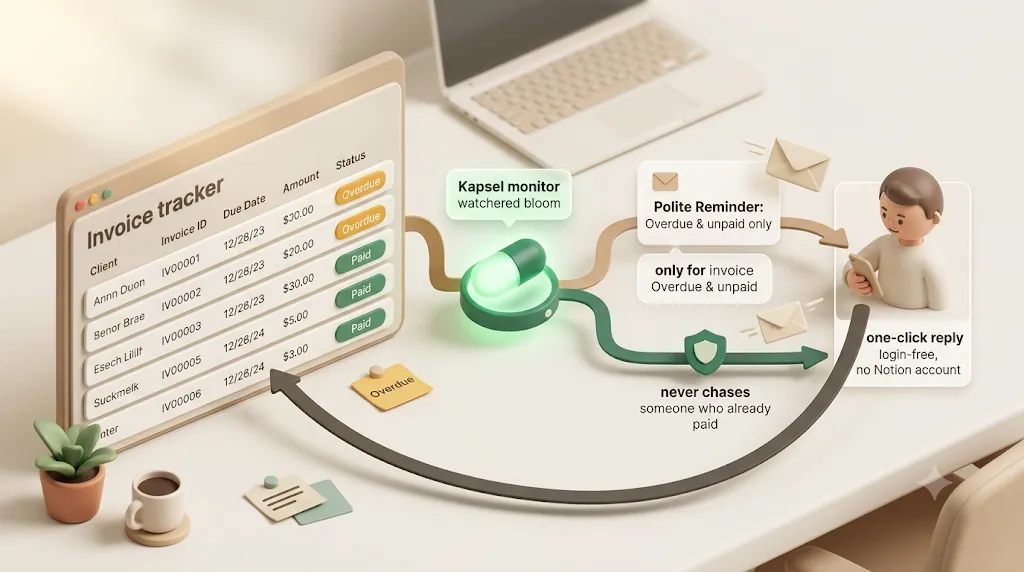
Every stage above assumes something is keeping track: which invoice is on which rung, when the last message went out, and who has paid. Do that by hand for one or two clients and it's fine. Do it for a dozen open invoices and it quietly becomes a part-time job — and the part that slips is usually the timing, so escalations fire late or not at all.
This is the gap most late-payment guides ignore: they hand you templates but assume you'll manually decide, each day, which client gets which message. If your invoices already live in Notion, you can automate the tracking and delivery while keeping full control of tone and timing — the same setup our freelance payment reminders guide walks through for solo billing. Kapsel is one tool built for exactly that; before it, plenty of freelancers wire together Notion's native automations, Zapier, Make, n8n, Google Apps Script, Slack, or manual reminders on a shared calendar. Those general-purpose approaches can work, but each has trade-offs for client-facing dunning.
| Approach | Reaches clients with no Notion account | Two-way status write-back | Skips already-paid items | Setup effort |
|---|---|---|---|---|
| Native Notion automations | Built to notify people inside the workspace | Manual | You build the filter yourself | Per-database, some config |
| Zapier / Make / n8n | Yes, if you add an email step | You build it | You build it | Multi-step, technical |
| Google Apps Script | Yes, if you code it | You code it | You code it | High; you maintain the script |
| Slack / Google Calendar reminders | No — reminds you, not the client | No | No | Low, but fully manual sending |
| Kapsel | Yes — plain email, no login | One-click confirm writes back | Built in | Connect workspace once |
Watching due date, assignee, and status in Notion so nothing slips through
Kapsel watches your Notion invoice tracker's due date, assignee, and status properties and acts on them automatically. When an invoice passes its due date and is still marked unpaid, it qualifies for a reminder — so nothing depends on you noticing it that morning. Your Notion database stays the single source of truth for what's owed and what stage it's at. In practice, that means one fewer thing to hold in your head each morning: you can trust the tracker instead of scanning invoices to figure out who still needs chasing.
Overdue follow-ups and target filtering so only the right invoices get chased
The ladder needs different treatment for different invoices, and most guides treat "send a reminder" as one-size-fits-all. Kapsel supports overdue follow-ups (repeat nudges on a cadence for items that stay unpaid) and target filtering, so you can chase only the invoices that qualify — for example, only those past a certain age, or only certain project types — rather than blasting everyone the same day. That precision means a client who's three days late gets a different tone than one who's a month overdue, without you having to sort the list yourself each time.
Reaching clients who don't use Notion, and letting their one-click confirmation write the status back
Your clients almost certainly don't live in your Notion workspace, and this is the piece generic "send it from your invoicing software" advice skips. Kapsel sends a plain email — no Notion account, no login, no guest invite. Each email includes a one-click confirmation button; when the client uses it, the status writes back into Notion automatically. So a client's payment confirmation is reflected in your own records without you manually editing a spreadsheet or database.
Recurring digests, a send log, and merge fields for scale
- Recurring digests give you a periodic rollup of everything currently overdue across all clients — genuinely useful once you're past a handful of open invoices.
- The send log records what was sent, to whom, and when. That's the automatic version of "document everything" — an always-on paper trail, rather than a folder of forwarded emails, ready if a dispute or collections step ever needs proof.
- Merge fields pull each client's name, invoice number, due date, and amount from the Notion row, so you maintain one template and every client still gets an accurate, personalized message.
Put together, these turn a dozen open invoices from a running mental tally into something you can check in on once and trust in between.
See the setup guide for the walkthrough, or the product overview for how the pieces fit together.
Preventing late payments in the first place
The cheapest invoice to chase is the one that's never late. Most late payments trace back to fuzzy expectations set at the start of the engagement, so tighten those:
- Put payment terms in writing. State the due window (e.g., net 14/30), accepted methods, and any late-fee or interest terms in a signed contract before work begins.
- Take a deposit. An upfront payment (a percentage before you start) filters out clients who can't or won't pay and reduces your exposure on the balance.
- Invoice promptly and clearly. Send the invoice the moment work is delivered, with the amount, due date, and payment methods unmissable.
- Set the reminder cadence up front. Decide your ladder — heads-up before due, gentle nudge after, firmer follow-up, and so on — before you ever need it, so escalation is routine rather than a decision made in frustration.
💡 A short "here's how billing works" note at kickoff prevents far more awkward conversations than any template can fix later.
For more on the sending side of this, see how email reminders reach clients who don't use Notion, automatic overdue invoice reminders from Notion, and keeping clients updated without extra check-ins.
Try Kapsel free. Kapsel watches your Notion due dates, assignees, and status, then sends automatic email reminders — including to people without a Notion account — with one-click write-back. Free plan, no credit card required. → Start with Kapsel
FAQ
How many payment reminders should you send before escalating to a formal demand letter?
There's no fixed number, but a common pattern is three to four escalating messages before a formal demand: a gentle reminder around the due date, a firmer follow-up with a deadline at ~1–3 weeks, and a notice that work is pausing around 3–4 weeks. If those go unanswered, a formal final demand around 30–45 days late is reasonable. Space them so an honest client has clear chances to pay, and document each one.
What should a friendly late payment reminder email say?
Keep it short, warm, and complete enough to act on. Include the invoice number, the amount, the original due date, and the accepted payment methods, and reattach or link the invoice. Assume good faith with a line like "it may already be on its way — if so, please ignore this," and close with an offer to help.
When should you send a final demand letter for an unpaid invoice?
Typically after your gentler reminders and firmer follow-ups have failed and the invoice is roughly 30–45+ days overdue. The demand letter should state the total owed, the invoice details, a firm final deadline, and the consequences of continued non-payment. Because it's the last step before collections or court, many people have a lawyer draft or review it, and the exact requirements vary by jurisdiction.
Is charging a late fee on an unpaid invoice legal?
In many places you can charge a late fee or interest if it was agreed in writing before the work started — usually in your contract or on the invoice. What's enforceable, and any cap on the rate, varies by country and state, and charging a fee you never disclosed can backfire. Confirm your local rules and put the terms in your contract from the start.
Should you pause work for a client who hasn't paid yet?
For ongoing or retainer work, pausing is often your strongest non-legal leverage once an invoice is significantly overdue, because it stops the balance from growing and turns an abstract debt into an immediate consequence. Give written notice, frame it as standard policy rather than punishment, and make resuming easy once payment clears. It's cleanest when your contract already allows suspension after a set number of overdue days.
When should you hire a collection agency instead of going to small claims court?
Choose a collections agency when you'd rather hand off the chasing entirely, the client is unresponsive (not actively disputing the work), and the amount doesn't justify your time in court. Choose small claims when the debt is well-documented, within your local claim limit, and you're willing to file and appear yourself. Larger or genuinely contested amounts may need civil court and a lawyer; thresholds vary by jurisdiction, so confirm your local limit first.
How much does a collection agency typically charge to recover a debt?
Agencies usually work on a contingency fee — a percentage of what they actually recover — commonly in the range of about 10–50%, with older and smaller debts costing more. You typically pay little or nothing if they recover nothing, but you net less of what you're owed. Rates and terms differ by agency and location, so confirm the exact percentage and conditions before signing.
How do you chase a late payment without damaging the client relationship?
Escalate the clarity and formality of your messages over time, never the hostility. Assume good faith early, stay calm and factual throughout, and treat escalation as consistent policy rather than a personal reaction. A systemic safeguard that never contacts a client who already paid — so no one gets an accusatory notice by mistake — protects the relationship more than any single well-worded email.
When should you stop chasing a debt and write it off?
There's no universal answer, but consider writing off a debt when the cost and time of pursuing it (collections fees, court costs, your own hours) exceed what you'd realistically recover, or when the client is insolvent or unreachable. Keep your full paper trail either way, since a written-off debt may have tax implications and rules vary by jurisdiction — a professional can advise on the specifics. Writing off one bad debt is often cheaper than months of chasing a client who will never pay.
How do you make sure a client isn't accidentally billed or reminded after they've already paid?
The reliable fix is a systemic rule rather than a memory check: a process that will not send to an invoice marked paid or completed. Kapsel is built this way — it never sends reminders to completed or paid items, so once a status is updated, no further nudge goes out for that invoice. Its one-click confirmation lets clients update that status themselves without a Notion account, which keeps your records current automatically.
Notes
Published 2026-08-04. Features and pricing described in this article are current as of writing. Kapsel watches Notion due dates, assignees, and statuses and sends email reminders to recipients who do not need a Notion account; a one-click confirmation in each email writes the status back to Notion, and reminders are never sent to completed or paid items. Kapsel also supports overdue follow-ups, target filtering, recurring digests, a send log, and merge fields; the Pro plan adds multiple Notion workspaces and sender branding. Pricing referenced: Free $0, Standard $12, and Pro $29 per month (USD); see current pricing for plan details. This article is general information, not legal advice — collections rules, late-fee limits, small-claims thresholds, and court procedures vary by country and state, and change over time; confirm current rules with a qualified professional or your local court before acting.