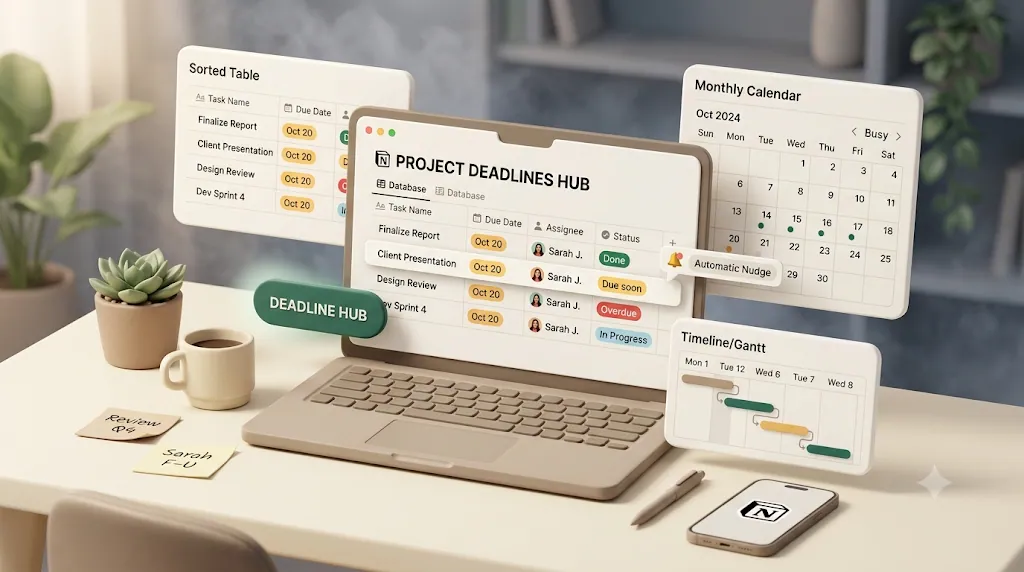
How to Automate Notion Reminders with Zapier: Setup, Pricing, Limits, and When to Use It
Key takeaways (TL;DR)
- Zapier can automate due-date reminders by combining Schedule by Zapier (a daily run) + finding Notion items + a filter + an email/Slack action. Its biggest strength is connecting to thousands of other apps.
- But Notion's Zapier triggers are polling-based (they detect item create/update)—"a due date arrived" can't be the trigger itself. Reminders are built with a scheduled run + a date filter.
- A useful reminder is usually multi-step, so it needs a paid plan, and every run consumes a task. Cost gets hard to predict as rows × frequency grow.
- Zapier struggles with three things: reaching people who don't use Notion, never sending to done/paid items, and letting a recipient's click update Notion (two-way). None are impossible, but each takes custom building and upkeep.
- What Kapsel is: a notification tool that watches your Notion due dates, assignees, and statuses, emails reminders to anyone (including people with no Notion account), and writes the status back to Notion when the recipient clicks once. It never sends to items already marked done or paid. This article compares it with Zapier fairly.
You've got a Notion due date and someone who needs to know about it before it slips, so you open Zapier—it's the obvious first stop for wiring Notion to anything else, and yes, you can build a reminder with it. But the moment you try to implement "email the assignee three days before the due date," "stop once it's done," or "reach a client who doesn't use Notion," what looked like a two-minute automation turns into a multi-step Zap you now have to babysit—more steps than you'd expect, each one something you maintain. This article lays out how to build reminders in Zapier, the real pricing and limits, and how it compares with Make, Google Apps Script, native Notion, and Kapsel—from a neutral point of view.
| Question | How Zapier handles it |
|---|---|
| What triggers a due-date reminder | Notion triggers detect create/update (polling). "Due date arrived" is built with Schedule by Zapier + a date filter |
| Who it reaches | Email, Slack, SMS and many more. But it tends to be one-way for external recipients |
| Stop sending once done | Branch with a filter on status (you maintain the condition yourself) |
| Two-way (reply updates Notion) | "Update Data Source Item" can update Notion, but "recipient clicks → Notion updates" needs a form/webhook you build |
| Pricing | Multi-step is paid. Each run consumes a task. Cost grows with rows × frequency |
What Zapier can do: the basic reminder setup
Zapier builds workflows (Zaps) as trigger → action. Notion is one component inside that. First, the basics of Zapier's Notion integration.
Notion triggers detect "create" and "update" (polling)
Zapier's main Notion triggers are New Database Item and Updated Database Item. They check Notion at intervals and fire when they detect a change (polling).
The key point: the passage of time itself—"the due date arrived"—can't be a trigger. "Three days before" or "past the deadline" are just time moving forward, unrelated to creating or updating an item, so those triggers won't catch them.
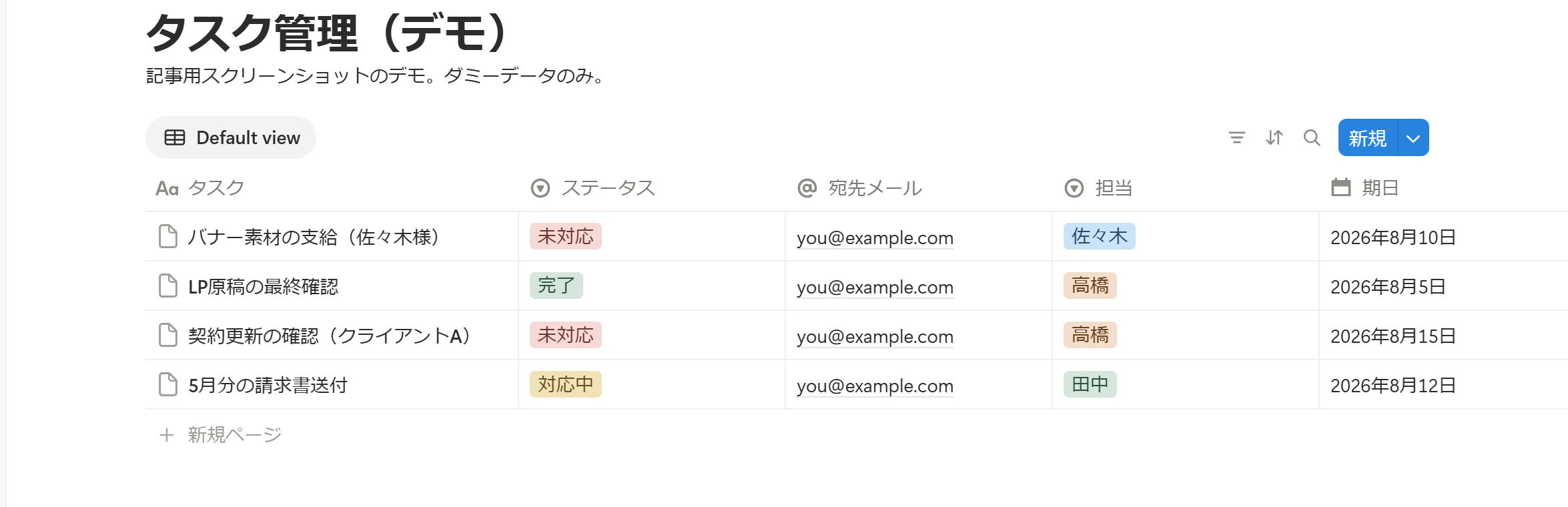
Build reminders with "Schedule by Zapier + a filter"
So a due-date reminder is usually built like this:
- Schedule by Zapier (a scheduled trigger that fires at a set time each day)
- Find/Search Notion items (or pull all and loop)
- Filter by Zapier (keep only "due in 3 days," "status not done," etc.)
- Action (send via Gmail / Slack / email)
In other words: check Notion every morning and send only the rows that match. It's sensible—but as noted below, it becomes multi-step (a paid plan) and consumes a task on every run.
A wide range of destinations
Zapier's strength is the sheer number of destinations. Gmail, Outlook, Slack, LINE, Discord, SMS—you can pipe into thousands of apps Zapier supports. For internal automation like "post a Notion update to Slack" or "email us about a new customer," it's especially powerful.
Step-by-step: a reminder in Zapier (example: email 3 days before due)
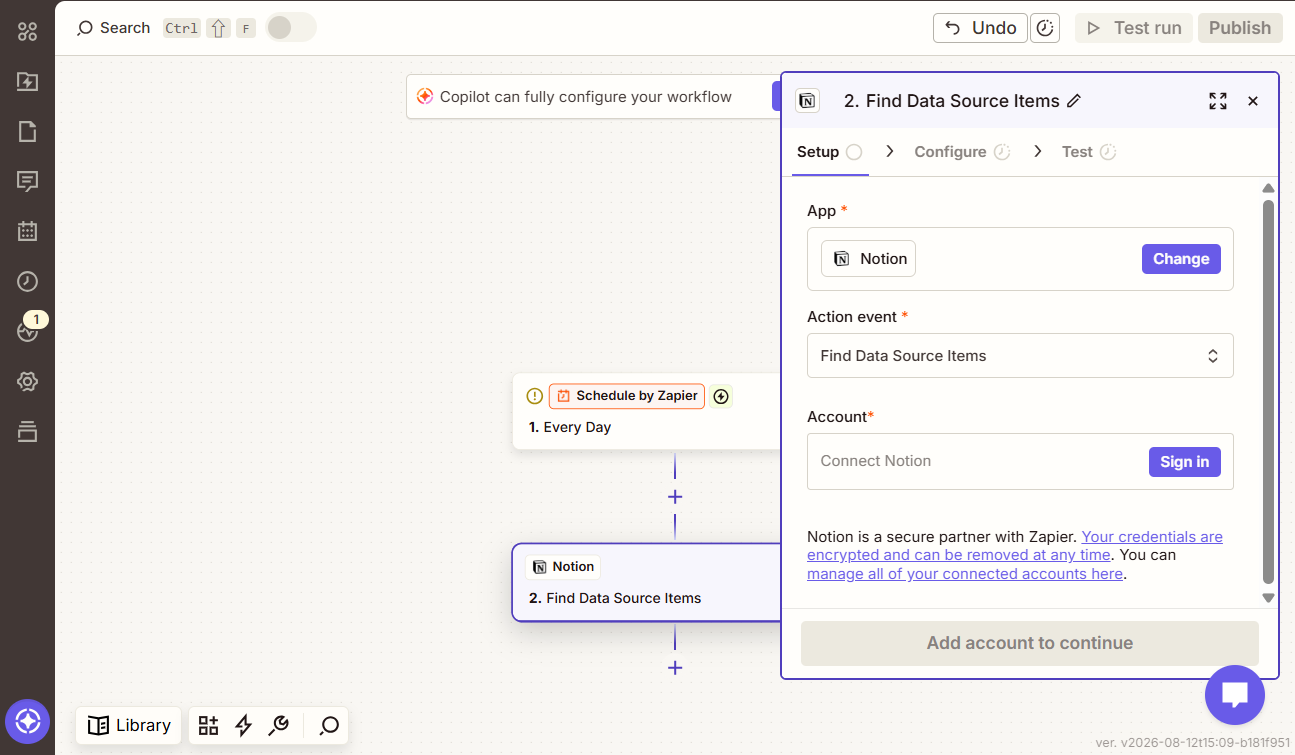
To make it concrete, here's the minimal flow for "email the assignee three days before the due date" (screen names can change as Zapier updates its product).
- Create a new Zap and choose Schedule by Zapier as the trigger. Set frequency to "Every Day" and pick a time (e.g., 9 a.m.).
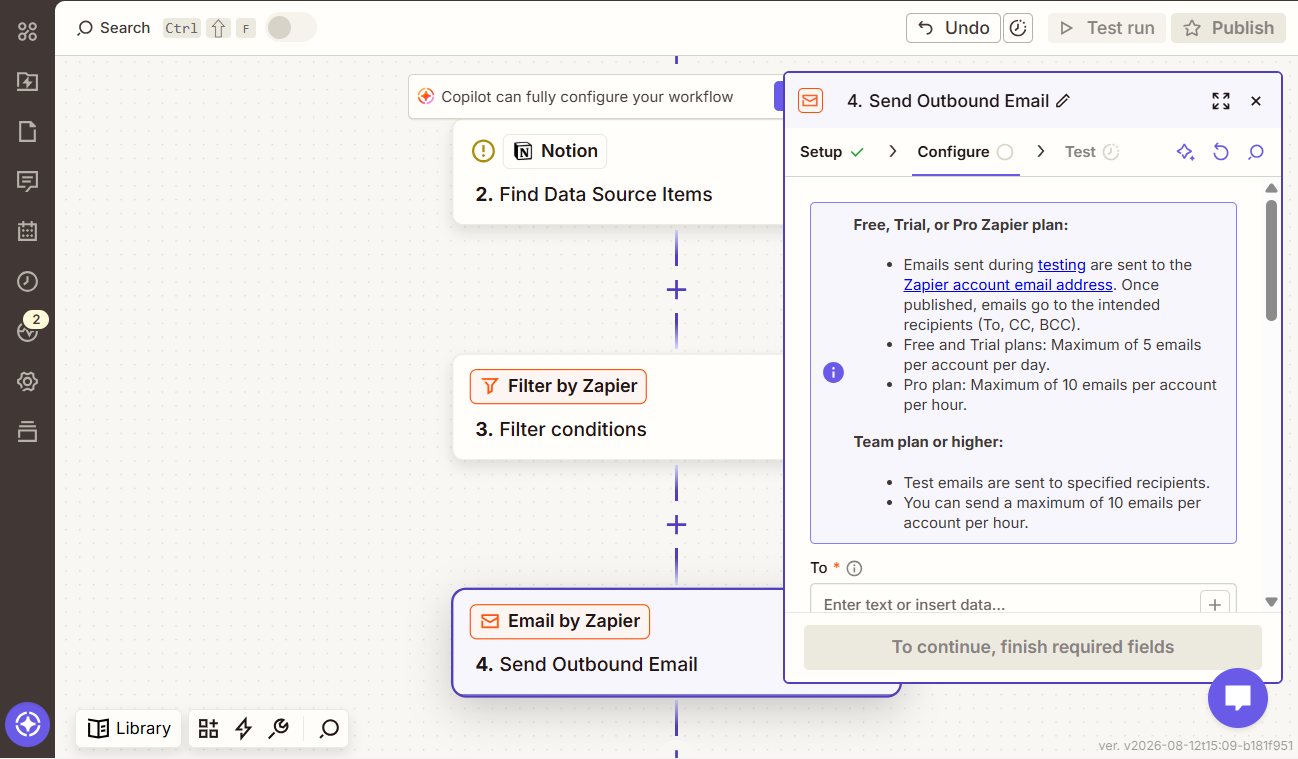
- Add Notion → Find Data Source Items, select the database, and set a condition on the due-date property (depending on your plan/setup you may instead pull all and loop). Note: Zapier now labels Notion databases as "data sources," and this step asks you to connect your Notion account (Sign in).
- Add Filter by Zapier with "due date = 3 days from today" and "status ≠ Done."
- Add Gmail / Email by Zapier → Send Email, with the assignee's email as the recipient and the Notion task name and due date merged into the body.
- Test, confirm only the intended rows send, and turn it on.
Follow these five steps and the reminder works—but each one is a piece you're now responsible for keeping in sync as your database evolves. By now you have four or more steps. Zapier's free plan is generally single-step (trigger + one action), so this setup assumes a paid plan (plan details change, so check the official page for the latest).
💡 Tip: A due-date reminder is "run daily and pick only the rows to send today." That means it consumes a task every day, including days with nothing to send. More databases and more rows mean more consumption.
The real cost model (task-based billing, polling intervals)
Zapier is a well-made tool, but for reminders the cost is easy to lose track of. Pricing changes, so always confirm the latest on the Zapier pricing page. Here are general tendencies at the time of writing.
- Task-based billing: A Zap consumes a "task" every time it runs. Because it's counted per action that fires, reminders that send daily to many rows use up tasks quickly.
- Multi-step is paid: A useful reminder (schedule + search + filter + send) is multiple steps, which the single-step free plan can't build.
- Polling intervals: Update-detection Zaps check on longer intervals on lower plans (roughly a few minutes to 15 minutes, depending on plan). Even scheduled Zaps have limits on send-time granularity.
- Premium apps: Some actions are limited to higher plans. In practice, building a real reminder makes Filter a Pro-plan feature, and the editor shows a "this Zap is using 1 Pro feature" banner at the top.
- Built-in email sending limits: Zapier's native "Email by Zapier" has send limits—5 emails per account per day on Free and Trial plans, and 10 per hour even on Pro (per the official note inside the action, at the time of writing). For daily reminders to many recipients, this cap matters too.
The cost is set by "how many times a task runs per day," not "how many messages you send per month"—which is easy to misjudge if you think in per-message terms.
What Zapier isn't great at (three reminder-specific walls)
Zapier is a near-universal automation platform, but narrowed to the single job of "delivering a Notion due date to a person," three things take effort. This isn't about Zapier being better or worse—it's about fit for the use case.
Wall 1: it tends to be one-way for people who don't use Notion
Sending email to external people works. But completing "the recipient sends their status back, and it updates Notion" with Zapier alone isn't easy. It tends to be fire-and-forget (one-way), and pulling replies back in needs a separate mechanism.
Wall 2: you must maintain "don't send to done/paid" yourself
Double-chasing is the accident you most want to avoid with external recipients. In Zapier you can prevent it by branching on status with a filter, but you have to design that condition and maintain it as Notion's values drift (renamed options, new statuses). Rename a property and the Zap can quietly break.
Wall 3: click-to-update-Notion (two-way) means building it yourself
Zapier has Update Data Source Item, so updating Notion is possible. But to make "the recipient taps a button in the email → the Notion status changes," you need to build the form or webhook the button points to and wire it into Zapier. That goes beyond no-code into real assembly.
How it compares with Make, GAS, and native Notion
The alternatives each have different strengths.
- Native Notion: Date-property reminders and mention notifications are easy, but they only reach people who have a Notion account. They don't reach external recipients.
- Make (formerly Integromat): No-code automation similar to Zapier that tends to be cheaper on a per-operation basis. You can build complex branching/loops visually, but more scenarios mean more upkeep, and external/two-way still needs custom building.
- Google Apps Script (GAS): You can hit the Notion API and build free, time-triggered notifications. Flexible, but it assumes you maintain code and tends to become person-dependent.
Weighing these before you commit means you pick the tool that matches your actual reach and update needs, instead of migrating later once you've hit a wall. There's a separate article comparing all of these side by side. For a bird's-eye view of tool selection, see Automate Notion Reminders and Notifications.
Where Kapsel fits (built for external + two-way)
Where Zapier is a general-purpose automation platform that connects any app, Kapsel is a notification tool focused on the single job of delivering a Notion due date to a person. The difference is that it handles the three walls above as standard features, not setup.
- Reaches people who don't use Notion: all the recipient needs is email—no app, no sign-up, no login.
- Never sends to done/paid: it checks the latest status right before sending and skips the item if it's done or paid, preventing double-chasing by design.
- The recipient's one click writes back to Notion (two-way): tapping the button in the email updates the Notion status—no form or webhook to build.
- Overdue follow-ups, target filtering, recurring digests, a send log, merge fields: the pieces a reminder needs, chosen in a settings screen instead of stacking Zap steps.
In practice, that means you get the external + two-way reminder Zapier makes you assemble by hand, already built in and ready from a settings screen.
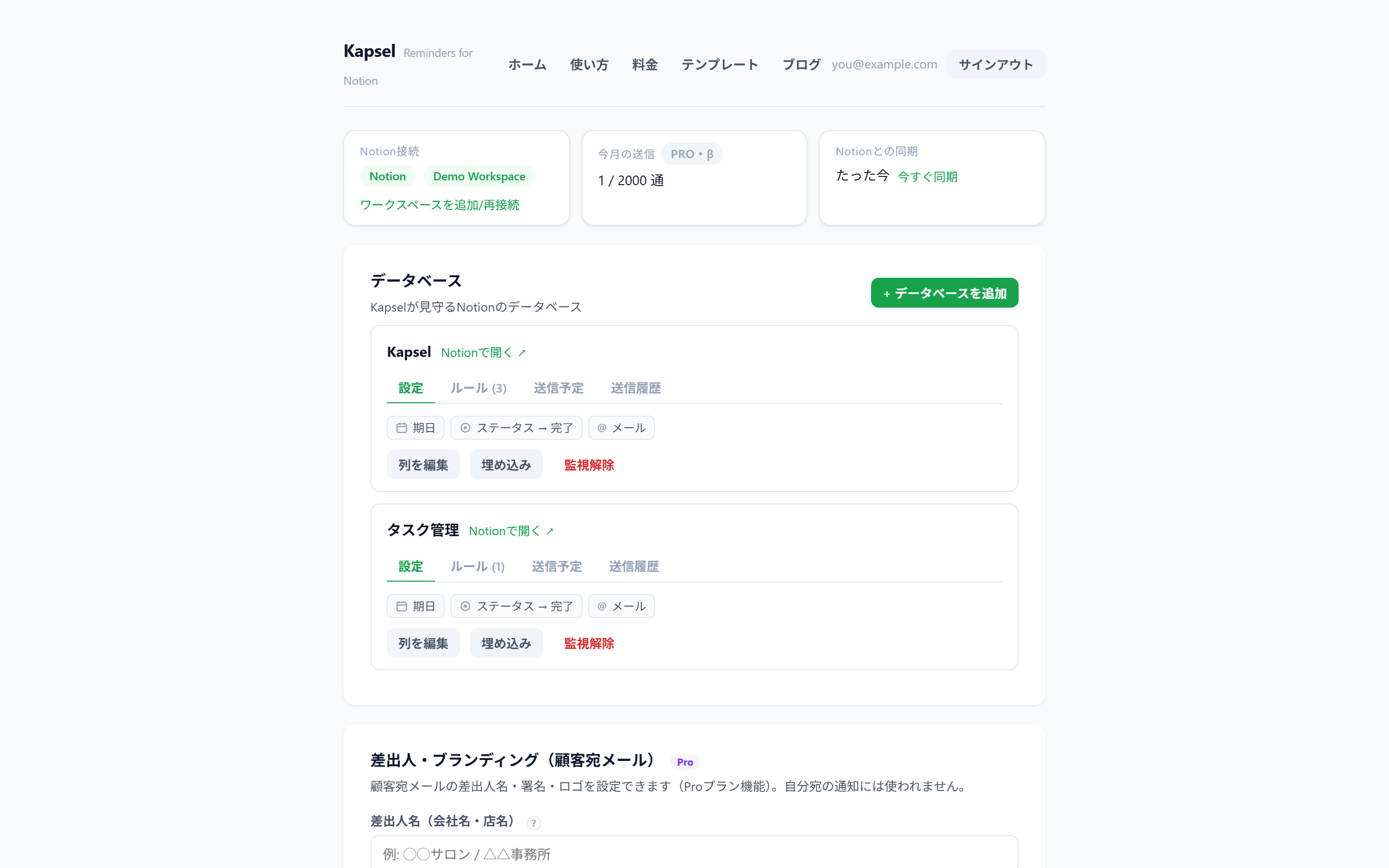
Pricing starts at a free plan ($0). Standard, which sends to external recipients, is $12/month. See Pricing for details. Note that Kapsel isn't an invoicing tool—it automates the "announce, confirm, and chase" that comes after an invoice is issued.
⚠️ Note: This doesn't make Zapier unnecessary. Complex internal automation that spans many SaaS beyond Notion is exactly what Zapier and Make are good at. Narrowed to "external due-date reminders plus reply-driven Notion updates," Kapsel is the better fit—a division of labor.
Which should you choose (by case)
- Internal task notifications are enough → native Notion + Slack, or a light Zapier/Make setup.
- You need complex automation spanning many SaaS beyond Notion → Zapier / Make.
- You have an engineer and want to build it for free → GAS.
- You want to reach clients/customers who don't use Notion and update Notion from their reply, or automate payment chasing → Kapsel.
Frequently asked questions (FAQ)
Can Zapier trigger directly on "the Notion due date arrived"?
No. Zapier's Notion triggers detect create/update (polling); the passage of time itself can't be the trigger. Use Schedule by Zapier to run daily and filter by date.
Can I build Notion reminders on Zapier's free plan?
A practical due-date reminder is a multi-step flow (schedule + search + filter + send), which is hard on the single-step free plan. In most cases a paid plan is required. Check the official page for current limits.
Can Zapier "not send once it's done"?
Yes. Use Filter by Zapier to exclude items whose status is done. But you design the condition and maintain it as Notion's values change.
Can a recipient's button tap update Notion, in Zapier?
Updating Notion (Update Data Source Item) is possible, but making "email button → Notion update" work requires building a form or webhook for the button and wiring it into Zapier. It isn't complete with standard steps alone.
Which is cheaper, Zapier or Make?
Generally Make tends to be cheaper on a per-operation basis, but it depends on the complexity of your workflow and how often it runs. Both change pricing, so confirm the latest official information.
How do I remind a client who doesn't use Notion?
Sending email is possible in Zapier itself. But once you include "the reply updates Notion," custom building is needed. If you want external + two-way as standard, a purpose-built tool like Kapsel becomes an option.
This article is produced by Kapsel. The specs and pricing of Zapier, Make, and Notion are best confirmed on each company's official sources. Kapsel is not affiliated with or endorsed by Notion Labs, Inc. or Zapier Inc. Information reflects the time of writing.